
Customer expectations have changed dramatically. People want quick answers, personalized interactions, and support that is available whenever they need it. For businesses handling hundreds or thousands of customer conversations every day, traditional support methods can become expensive and difficult to scale….
That is where AI customer support software comes in. Modern artificial intelligence tools can automate routine conversations, understand customer intent, recommend solutions, and help human agents resolve complicated issues faster.
This ultimate guide explains how AI customer support software works, its benefits, essential features, use cases, and what businesses should consider before choosing a solution.
Must Read:Ultimate Guide to AI Marketing Tools
What Is AI Customer Support Software?
AI customer support software is a technology platform that uses artificial intelligence, machine learning, natural language processing (NLP), and automation to manage customer service interactions.
Unlike basic rule-based chatbots, modern AI support systems can understand conversational language and respond based on context. They can assist customers through websites, mobile applications, email, social media, and other communication channels.
AI customer service platforms can answer frequently asked questions, troubleshoot common problems, collect customer information, and transfer complex conversations to human agents when necessary.
The goal is not simply to replace support employees. Instead, the best systems combine automation with human expertise.
How Does AI Customer Support Work?
AI customer support typically combines several technologies to understand and respond to customer requests.
Natural Language Processing
NLP enables software to understand human language. Customers do not need to use specific commands or keywords to receive assistance.
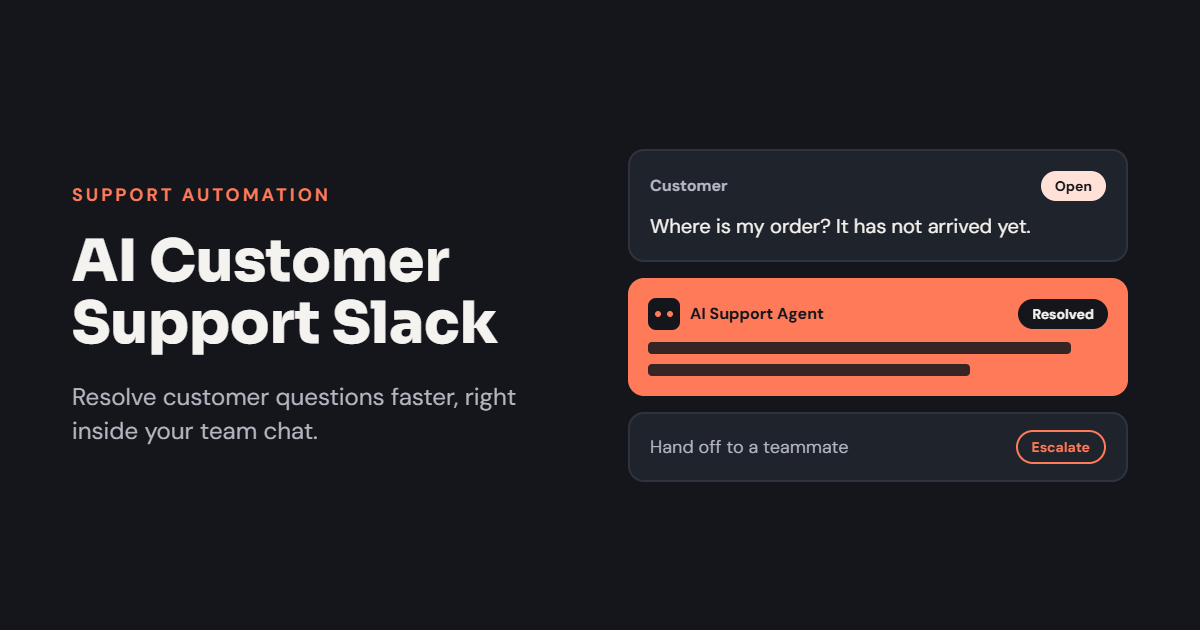
For example, a customer might write, “My order still hasn’t arrived. Can you check what’s happening?” The AI can identify the intent as an order-status request and provide an appropriate response.
Machine Learning
Machine learning helps AI systems improve their ability to recognize patterns in customer interactions. As businesses process more conversations and feedback, the system can become better at identifying common questions and recommending relevant responses.
Knowledge Base Integration
Many AI support platforms connect directly to a company’s knowledge base. This allows the system to retrieve information from FAQs, product documentation, policies, help articles, and internal resources.
This is particularly useful because AI responses can be grounded in information that the business has already approved.
Key Benefits of AI Customer Support Software
Businesses adopt AI-powered customer service for several practical reasons.
24/7 Customer Assistance
AI-powered support does not need to follow traditional business hours. Customers can receive answers during evenings, weekends, holidays, and other periods when human agents may be unavailable.
This can be particularly valuable for global businesses serving customers across different time zones.
Faster Response Times
Customers generally do not want to wait hours for a simple answer. AI customer support tools can respond to many routine requests almost immediately.
Faster responses can improve the overall customer experience while reducing the number of conversations waiting in an agent queue.
Lower Support Costs
Automating repetitive tasks can reduce the amount of manual work handled by support teams. Agents can spend less time answering the same basic questions and more time handling issues that require judgment or empathy.
The savings depend on implementation, conversation volume, and the complexity of customer requests.
Improved Agent Productivity
AI can support human representatives with suggested replies, conversation summaries, knowledge recommendations, and automated ticket classification.
Instead of searching through multiple systems for information, agents can receive useful context directly within their support workflow.
Personalized Customer Experiences
Advanced AI customer service software can use customer and conversation data to tailor responses.
For example, an AI system may recognize a returning customer, identify their previous support history, and provide assistance based on their specific situation.
Essential Features to Look For
Not every AI support platform offers the same capabilities. Businesses should evaluate features based on their actual support requirements.
AI Chatbots and Virtual Agents
AI chatbots can handle common questions, guide customers through troubleshooting, and complete simple support tasks.
The strongest systems allow customers to move naturally between automated assistance and human support.
Omnichannel Support
Customers may contact a business through email, live chat, social media, messaging apps, or a website.
An effective AI customer support solution should provide a consistent experience across relevant channels rather than forcing customers to repeat their information.
Human Handoff
AI should know when it cannot confidently solve a problem.
A reliable platform should transfer complicated or sensitive conversations to a human agent while preserving the relevant conversation history and customer context.
Analytics and Reporting
Support managers need visibility into performance. Look for dashboards that track metrics such as response time, resolution rate, ticket volume, customer satisfaction, automation rate, and escalation frequency.
These insights can reveal where customers experience recurring problems.
CRM and Help Desk Integration
Integration with CRM, help desk, ecommerce, and business applications can make AI support significantly more useful.
Connecting customer data with support conversations gives AI the context required to provide more relevant assistance.
Common Use Cases for AI Customer Support
AI customer support software can be applied across many industries.
Ecommerce businesses can automate order tracking, returns, refunds, product questions, and delivery updates.
SaaS companies can use AI to answer technical questions, guide users through features, and troubleshoot common issues.
Financial services companies can use conversational AI for general account questions, application guidance, and service information, while routing sensitive matters to qualified employees.
Healthcare organizations can use AI for administrative questions, appointment information, and general guidance, while keeping clinical decisions under appropriate human oversight.
How to Choose the Right AI Customer Support Software
Start by identifying your biggest support challenges. Do you have too many repetitive tickets? Long response times? High support costs? Limited coverage outside business hours?
Once the problem is clear, compare platforms based on AI capabilities, integrations, scalability, security, analytics, customization, and pricing.
Do not choose software simply because it has an impressive AI demo. Test it with real customer questions.
Pay close attention to accuracy. An AI system that produces fast but incorrect answers can damage customer trust faster than a slow support process.
It is also important to evaluate data protection, access controls, audit capabilities, and compliance requirements relevant to your industry.
Best Practices for Implementing AI Customer Support
Successful implementation requires more than installing an AI chatbot.
Start with a focused set of repetitive, low-risk support requests. Build a reliable knowledge base and regularly review AI responses.
Give customers an easy way to reach a human agent when automation is not appropriate.
Monitor conversations after launch and identify incorrect answers, unresolved requests, and frequent escalations. Use these insights to improve both the AI system and the underlying customer experience.
Most importantly, treat AI as part of your support strategy rather than the entire strategy.
The Future of AI-Powered Customer Service
AI customer support is moving toward more proactive and context-aware service. Future systems will increasingly combine conversational AI, predictive analytics, workflow automation, customer data, and real-time recommendations.
Instead of waiting for customers to report problems, businesses may use AI to identify potential issues and offer assistance before frustration develops.
However, human support will remain important. Customers dealing with complex, emotional, or high-value situations often need judgment and empathy that automation cannot reliably provide.
Final Thoughts
AI customer support software can transform customer service by reducing repetitive work, improving response times, increasing agent productivity, and providing assistance around the clock.
But the technology is not automatically effective. Businesses need accurate information, thoughtful workflows, appropriate human oversight, and continuous monitoring.
The best approach is simple: automate what AI can handle reliably, give employees better tools for complex problems, and keep the customer experience at the center of every decision. Done correctly, AI becomes more than a chatbot—it becomes a scalable customer service infrastructure that helps businesses serve customers faster and more efficiently.
10 thoughts on “Ultimate Guide to AI Customer Support Software”